
Arctic Norway at a Gentler Pace: Planning for Limited Mobility

A good Arctic journey does not depend on being able to hike for six hours or sit on a snowmobile. Some of the best moments in Northern Norway are experienced from a warm vehicle, a window seat in a lodge or a viewpoint a few metres from a car. The landscape does much of the work. What matters is that the journey has been planned with honesty about what you can and cannot comfortably do.
This article is for travellers who have reduced mobility, who travel with someone who does, or who simply want an easier pace: older couples, guests recovering from an injury, people with a long-term condition, and families with a grandparent in the group. It sets out how we think about planning in these cases, what the winter environment asks of a body, how a day can be shaped around comfort, and what to tell us at the start.
We should say plainly at the outset that we do not make promises we cannot keep. Winter terrain is uneven and slippery, facilities vary from place to place, and the right plan depends on the individual. What we can do is plan carefully, ask the right questions and tell you what we think is realistic.
Start with an honest conversation
The most useful thing you can do is tell us what you need before anything is booked. We would rather hear about a knee, a pacemaker, a wheelchair, a walking stick or a fear of heights at the beginning than discover it on the day. Everything is easier when it is known in advance, and nothing you say will make us think less of the journey you want.
Useful things to tell us include:
How far you can comfortably walk on level ground, and how you manage steps and slopes.
Whether you use a wheelchair, walker or stick, and whether you can transfer into a vehicle without help.
How you cope in the cold, and how long you are comfortable outside.
Any medical needs, medications or equipment, and any time-of-day constraints.
Dietary requirements, sleep needs and the pace at which you like to travel.
A personal consultation, which is included in every journey, is the right place for this. A consultant will ask follow-up questions, check what is realistic, and reply with a first plan within one business day.

What winter asks of the body
It is worth being clear about what makes the Arctic in winter physically different, so that you can judge for yourself.
Ice and snow underfoot. Pavements and paths may be icy or covered in packed snow. Even short walks can be slippery, and good grip on footwear matters. Some tours provide insulated boots and thermal suits on very cold days, but you should not assume a particular item without confirming it.
Cold. Cold air can tire people more quickly than expected, and some medical conditions are affected by it. The answer is layering, careful pacing and warm places to rest, rather than endurance. A wool base layer, a warm mid-layer, a wind and waterproof outer layer, a hat, mittens and insulated boots are the basics.
Darkness. From late November to mid-January the sun does not rise above the horizon in Tromsø. The sky still glows around midday, but evenings and mornings are dark, and low light makes uneven ground harder to read. Some travellers find the winter light restful; others find it tiring. If it concerns you, consider February to April, when the days are longer, or the autumn.
Long days. Northern lights evenings are late. A private chase can run for five to eight hours, which is a lot for anyone. A shorter outing, with an early finish, is often a better fit.
Experiences that suit a gentler pace
Many of the most rewarding experiences in Northern Norway are low-effort. A private guide and driver can make them even easier.
Scenic fjord days by vehicle
A private fjord day takes you through coastal villages and mountain scenery with frequent stops, often at places a few steps from the vehicle. The route is chosen daily according to the weather. It is suitable for all ages and can be as slow as you like. Our Sommarøy and Kvaløya private fjord day shows how this works.
Northern lights from a warm place
A private northern lights outing can be shaped around comfort. The guide chooses a location according to the weather and the sky, and you can watch from a short distance of the vehicle, with warm drinks and a heated place to return to. The northern lights are never guaranteed. Our guide to a private northern lights chase for two explains how an evening is run.
Reindeer and Sámi culture
A visit with reindeer and an introduction to Sámi culture can be adapted to the group's mobility. Please ask us what is realistic at the time of year you are travelling.
Food and quiet
Culinary journeys with local ingredients and fine wines are among the finest experiences in the region and require no effort beyond sitting down. Long lunches by a window and an evening in a lodge by a fire are as much a part of the journey as anything outdoors. Our guide to luxury lodges in Northern Norway describes this kind of stay.
Choosing where to stay
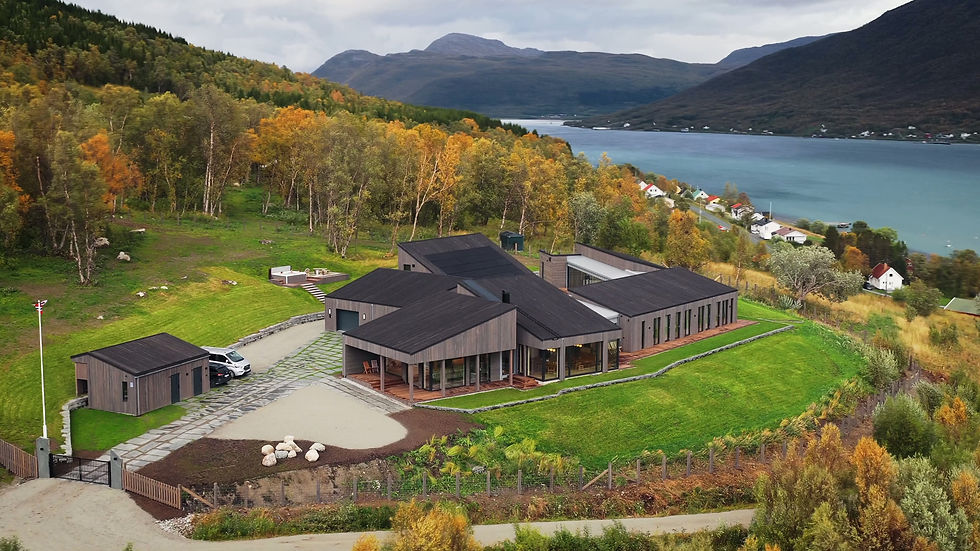
Accommodation is one of the most important choices on an accessible journey. We work with luxury Arctic lodges, exclusive private apartments and secluded wilderness cabins, and the right choice depends on what you need. We do not name properties in public, and we do not claim that every property is suitable for every need. What we can do is ask about stairs, bathroom layout, distances from the car to the door and the surface of the paths, and advise you accordingly.
As a general guide, a city-based stay tends to offer shorter distances to restaurants and services, while a lodge on the coast offers peace and views but may involve longer drives. A wilderness cabin is atmospheric but may be less suited to someone who needs easy access. Our article on wilderness cabins versus city hotels sets out the trade-offs.
Think too about where you will rest. A ground-floor room, a comfortable chair with a view and a place to put your feet up matter more on a gentle journey than a long list of experiences.
A sample four-day journey at a gentle pace
This is an outline, not a package. Every plan is adjusted to the individual.
Day one: Private transfer from the airport in a premium Mercedes with a professional driver. Settle into your accommodation. A simple dinner nearby.
Day two: A late start. A slow scenic drive along the coast with stops at viewpoints, a long lunch and an early return for a rest. In the evening, a short private northern lights outing, with a warm vehicle close at hand.
Day three: A morning of quiet, perhaps a visit with reindeer if suitable. The afternoon is free. A second aurora opportunity, if the sky and your energy allow it.
Day four: A final easy morning, a farewell meal and a private transfer to the airport.
The pattern is one main activity per day, plenty of rest, and spare evenings held in reserve. If you are tired, you skip something. If the sky is clear, you go out.
Practical matters before you go
A few things are worth sorting out well in advance. Travel insurance should cover your medical needs and any winter activity; our guide to insurance and documents for Arctic travel explains what to check. Medication should be carried in your hand luggage, with a copy of the prescription. Allow for a rest day after a long-haul flight; jet lag is real, and an easy first evening helps. If you use mobility equipment, tell us early so we can plan vehicles and transfers; do not assume that a particular vehicle or facility can accommodate it without asking.
Finally, give yourselves time. We recommend planning six to twelve months ahead for a tailor-made journey, and accessible plans benefit from the extra choice that comes with early planning. Our guide to how far ahead to book explains the timing in more detail.
Questions to ask any provider
Whoever you plan with, it is worth asking a few direct questions, and a good provider will welcome them. How will the vehicle be arranged for someone who needs help getting in and out? What is the surface and distance between the vehicle and the place where you will stand? Are there stairs or steps at the accommodation, in the bathroom, at the entrance? How long will each outing last, and can it be shortened on the day? Is there somewhere warm to rest, and is it close? What happens if the weather changes or you feel unwell?
The answers tell you a great deal about whether the plan is real. Be wary of any provider who promises that everything is suitable for everyone. In the Arctic, in winter, that is not credible. A reliable answer sounds more like "that part is possible, this part is not, and here is what we suggest instead."
It is also reasonable to ask for flexibility on the day. A private journey allows the pace to follow the person, not the programme. If energy is low, the afternoon outing is dropped and a warm lodge becomes the plan. If the sky is clear and energy is high, the evening is extended. That adaptability is the main reason many travellers with limited mobility choose a tailor-made journey over a fixed group tour.
Frequently asked questions
Can travellers with reduced mobility visit Arctic Norway?
Often, yes, with careful planning. Winter terrain is slippery and facilities vary, so the right plan depends on the individual. Tell us your needs at the start and we will say honestly what is realistic.
Are your vehicles suitable for wheelchair users?
We cannot promise this in general. Please tell us about the equipment you use and how you transfer, and we will check what can be arranged for your dates before you commit to anything.
Which season is easiest for a gentle journey?
Many travellers find February to April or the autumn easier, because the days are longer and the light is better for walking. Summer is mildest overall but still has uneven terrain in places.
Can I see the northern lights without a long outing?
Sometimes, with a private guide who chooses a location close to your vehicle and keeps the outing short. The northern lights are never guaranteed, and a flexible plan with spare evenings gives the best chance.
Who should I tell about medical needs?
Tell us in your first enquiry. A consultant will ask follow-up questions and adjust accommodation, vehicles and pace. Keep medication in your hand luggage and check that your travel insurance covers your needs.
Plan your Arctic journey
If you or someone travelling with you needs a gentler pace, tell us what is comfortable and what is not, and we will plan a realistic journey around it. We reply within one business day with first ideas.


Comments