
How far north is Tromsø? The Arctic Circle and what it means for your journey

Tromsø sits at roughly 69.6° north. The Arctic Circle runs at about 66.6° north, which puts the city around three degrees of latitude, a little over 300 kilometres, beyond the line. That gap is the reason Tromsø has a true polar night in winter and a true midnight sun in summer, and it is the reason the northern lights appear here with unusual regularity from autumn to early spring.
For anyone planning a journey, the useful question is not the number itself but what it changes: how much daylight you will have on a given day, how reliably the sky tends to be dark enough for the aurora, and how far north it is worth going when you build a route. This guide answers those questions the way we answer them for our guests, who are mostly two people travelling a long way and wanting the days to be well judged.
Where the Arctic Circle actually runs
The Arctic Circle is not a wall or a border but a line of latitude, and its position drifts very slightly over the years because of small changes in the tilt of the Earth's axis. North of it, the sun stays above the horizon for at least one full day around the June solstice and below it for at least one full day around the December solstice. In mainland Norway the line crosses the country in the county of Nordland, a good way south of Tromsø, which means that almost every destination we plan in Northern Norway lies on the far side of it.
Lofoten sits at roughly 68° north, comfortably inside the Arctic. Senja is a little further north again, and the Lyngen Alps and Tromsø are both around 69 to 70° north. Alta, further east along the coast, lies a touch beyond that. These figures are approximate, and it does not matter for planning whether a given village is a tenth of a degree one way or the other. What matters is that the whole region shares the same basic rhythm of light, with differences that come from the coast, the mountains and the weather rather than from latitude alone.
It also helps to know what the line is not. Crossing it does not bring an immediate change in climate. The coast of Northern Norway is warmed by the North Atlantic current, so winter temperatures in Tromsø are typically milder than most visitors expect for a city this far north, and the fjords rarely freeze. The Arctic here is a matter of light and landscape more than of extreme cold, which is a relief for many of our guests who arrive worried about the temperature.
What being so far north changes day to day
The clearest effect is on daylight. In Tromsø the sun does not rise above the horizon during the polar night, which runs from about 27 November to 15 January. That does not mean darkness all day. Around midday there is a soft blue and pink twilight that photographers call the blue hour, and it can last for several hours in early December. The light is gentle, the snow glows, and the city feels unhurried. We describe this season in more detail in our guide to the polar night in Tromsø.
The summer mirror image is the midnight sun, which in Tromsø runs from about 20 May to 22 July. For those weeks the sun does not set at all, and a late dinner on the water can finish in full daylight. Our overview of the midnight sun in Northern Norway explains how we shape days around it, because sleeping and eating well matters more when the sky gives no cues.
The shoulder months move fastest
The extremes are easy to picture. The months in between are where the light changes most quickly, and where a week's difference matters. From late January the sun returns and the days lengthen by several minutes each day, which by March gives long, bright afternoons and still plenty of dark evening for the aurora. In autumn the process runs in reverse. If you are choosing between two weeks, ask what you want from the light, not only from the calendar.
What it means for the shape of your day
In the polar night we plan slower mornings, a main outing in the soft midday light, and a private evening for the sky. In the midnight sun we do the opposite and protect sleep, with curtains, quiet rooms and a gentle schedule. Either way, being far north rewards a journey built around the light rather than a fixed list of sights.
Why latitude matters for the northern lights
The northern lights are caused by charged particles from the sun meeting the Earth's magnetic field and glowing high in the atmosphere. They tend to appear in a ring around the magnetic pole known as the auroral oval, and Tromsø sits under that oval. That is why the aurora here is often visible even when solar activity is modest, and why guides talk less about the KP index than visitors expect. Our guides rely on the cloud forecast far more than on the KP index.
Being under the oval is a good starting position, but it is not a guarantee, and we never promise the lights. Cloud is the usual obstacle. Our guides watch the cloud forecast closely, and when the sky over the city is grey they will often head inland or along a fjord, where the weather can differ within an hour or two of driving. A private evening gives you the freedom to follow the clear sky rather than a fixed route, which is one of the quiet advantages of travelling this far north with a local guide.
The season runs from September to early April. The darkest months are not necessarily the best, because the aurora needs dark skies and clear weather rather than polar night as such. Many of our guests prefer February and March, when the light returns, the temperatures are often steadier and the nights are still long enough. We suggest staying at least five nights so that you have several evenings to work with.
How far north should your base be?
Because the whole region lies beyond the Arctic Circle, the choice of base is about character rather than latitude. Each of our four main destinations suits a different kind of journey, and many of the best routes combine two of them.
Tromsø is the gateway: direct flights, a walkable city, dining, culture and the widest choice of experiences. Our page on Tromsø shows what is possible.
Senja is quieter and more dramatic, with jagged peaks that rise straight from the sea and very little traffic.
Lofoten is the best known, with red fishing cabins beneath steep mountains and a long, curving road along the islands.
The Lyngen Alps are the choice for ski touring and big alpine scenery, with an IFMGA mountain guide and an avalanche instructor on the Legendary team.
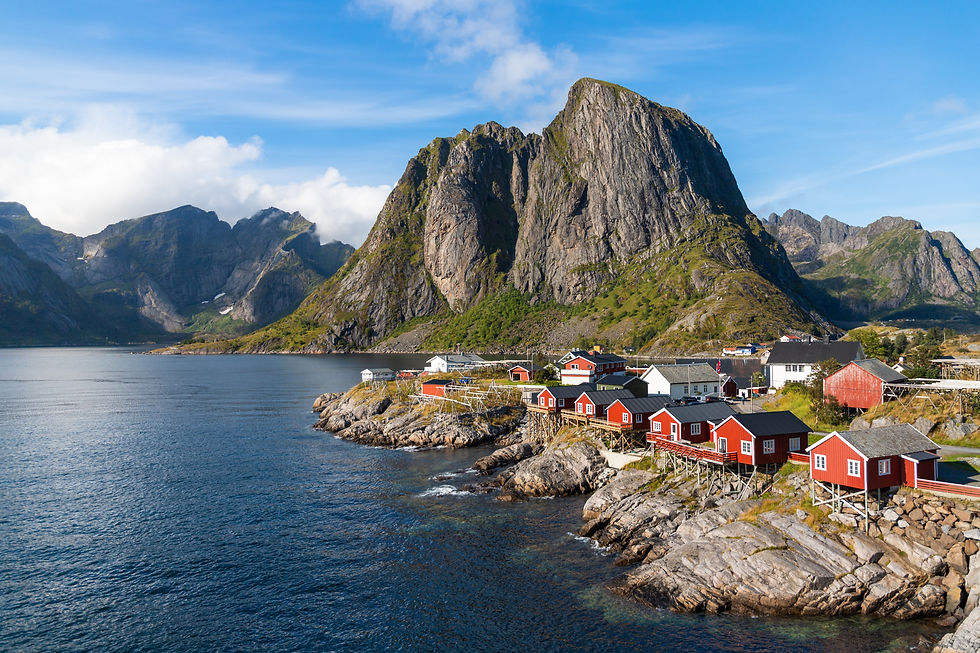
A first journey often works best with a single base for the first few nights and a second destination added for contrast. We cover the options on our destinations page, and we plan the transfers between them so that you are not repacking more often than necessary.
Book this if, skip this if
Book a Tromsø-only journey if this is your first time, you have four to six nights, and you want the aurora, the city and a few day outings without moving.
Add Senja if you would like quiet, space and mountain scenery, and you are happy with a longer day on the road.
Add Lofoten if the fishing villages and coastal drives are the reason you are travelling, and you have at least a week.
Skip an extra destination if you are travelling a long way for a short stay. Fewer moves usually means better days.
Planning around the line: seasons, arrival and pace
Most of our guests come from the United States and the United Kingdom, with many more arriving from Australia, Singapore and continental Europe. The journey north is long, and the first evening should be easy. We usually suggest a private transfer from the airport, a quiet dinner and an early night, with the first outing the next day once the body clock has adjusted. Flights typically connect through Oslo or other European hubs, and we are happy to talk through the practicalities when you write to us.
Dress for the wind more than the number on the thermometer. Wool next to the skin, a warm mid-layer, a wind- and waterproof shell, a hat, a scarf, mittens and insulated boots will carry you through most of the winter, and thermal suits are provided on some tours. We send a full packing list with every journey.
Finally, choose the season by what you want to feel. The polar night offers blue light and a hushed city. February and March give longer days and strong aurora chances. Summer gives long evenings on the water. We are glad to help you weigh them against the dates you have in mind, and the further ahead you write, the more choice there is, since we recommend six to twelve months for Christmas, New Year and peak winter.
Frequently asked questions
Is Tromsø inside the Arctic Circle?
Yes. Tromsø lies at roughly 69.6° north, well beyond the Arctic Circle at about 66.6° north. That is why the city has a polar night in winter and a midnight sun in summer, both of which we plan around when we design a journey.
How far is Tromsø from the Arctic Circle?
Roughly three degrees of latitude, which is a little over 300 kilometres. The exact line shifts slightly over the years, so treat the figures as approximate. For planning, what matters is that every destination we work with lies north of it.
When is the polar night in Tromsø?
The sun stays below the horizon from about 27 November to 15 January. Midday brings a soft blue twilight rather than full darkness, and it can be one of the most atmospheric times to visit, particularly if you want long nights for the aurora.
Does being further north mean more northern lights?
Not necessarily. The lights tend to follow a ring around the magnetic pole, and Tromsø sits beneath it, which is a good position. Weather and cloud matter as much as latitude, so we recommend several evenings and a guide who will chase clear skies. The lights are never guaranteed.
Is it much colder north of the Arctic Circle?
On the Norwegian coast, less than many visitors expect. The North Atlantic current keeps winter temperatures typically milder than the latitude suggests. Wind can make it feel colder, so layers and a proper shell matter more than the thermometer reading.
Plan your Arctic journey
Tell us which light you want to travel for, whether polar-night blue, the first sun of February or a summer evening that never ends, and we will shape a tailor-made journey around it. We reply within one business day with first ideas.


Comments