
Two Nights in the City, Three in the Wilderness: The Split Stay

For most couples, the best Arctic stay is not one place but two: a few nights in the city, then a few in the wilderness. The city gives you restaurants, culture and the easy logistics of an airport, while a lodge or cabin outside it gives you silence, darker skies and the feeling of having really left. Splitting your stay lets you have both without compromise.
The split stay is one of the most useful tools in our planning. It solves the question of where to sleep, shapes how the northern lights evenings work, and gives a long trip a natural rhythm. A common pattern is two nights in Tromsø and three in a more remote setting, though the proportions change with the season and the people travelling.
This guide explains how the split works, what each side offers, and when it is better to stay in one place. We keep property names out of our articles, and we match a stay to your journey when we design it. If you are still deciding between a city hotel and a cabin, you may also like our overview of luxury lodges in Northern Norway.
Why one base is not always enough
Tromsø is an excellent base. It has an airport with direct flights from Oslo and several European cities, a compact centre, good dining and a long list of experiences within easy reach. For short trips it is often the right and only choice.
The trade-off is light and silence. The city is bright, even in winter, and the northern lights can be seen from within it on good nights but are far better away from the street lamps. For many guests, the deepest memory of an Arctic journey is not a particular sight but a feeling: standing outside a cabin in complete quiet, with nothing but snow, stars and a stove burning behind. That is hard to reproduce in a city centre.
Equally, a remote stay for the whole journey has its own limits. Travel to and from the airport takes time, options for dining are narrower, and on a bad weather day there is less to do. The split stay is a way of using each setting for what it does best. The city carries the first part of the trip, with arrival, orientation and the cultural side. The wilderness carries the second, with space, sky and rest.
What the city half gives you
Tromsø is a real city, with a cathedral, a university, a waterfront of old wooden warehouses and a quiet confidence about being the gateway to the Arctic. Staying in the centre or in a private apartment nearby makes the early part of the trip easy. You land, you settle, and you have an evening in which you can walk to dinner.
It is also the right base for experiences that start from town. A private fjord day along Kvaløya and Sommarøy leaves from the city. So do a guided snowshoe hike, a reindeer and Sámi culture experience, and a dog-sledding session. We often put these early in the journey because they depend less on the sky and let you build up energy for the night-time part.
The city half is also where we place a buffer. If your flight is delayed, if you are tired from a long-haul trip, or if the weather rules out an early plan, the city offers alternatives. A museum, a spa session, a long lunch. We say more about arrival in our piece on jet lag and arrival.
What the wilderness half gives you
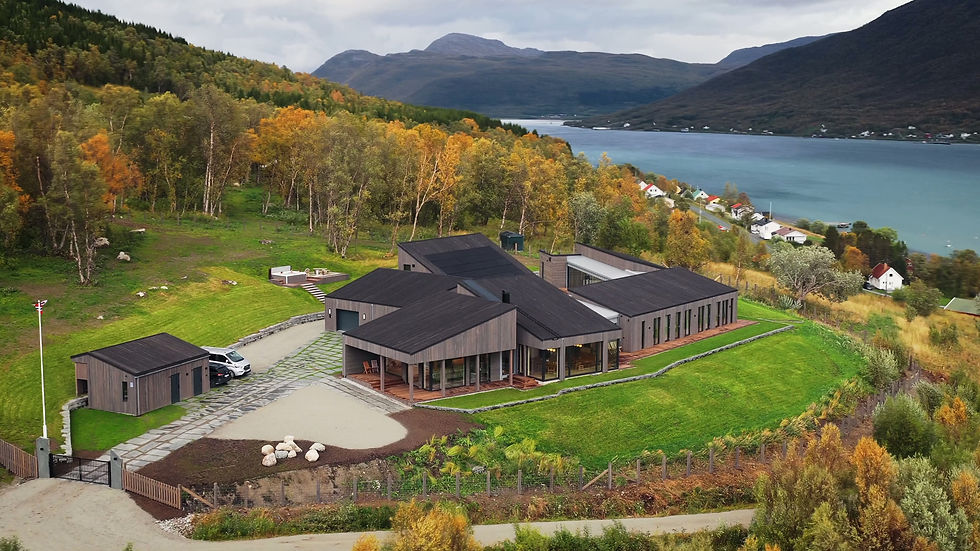
A wilderness stay might be a secluded cabin by a fjord, a lodge with large windows facing the mountains, or a private house. The point is not luxury in the sense of marble and staff. It is luxury in the sense of space, quiet and privacy.
Darker skies
Away from the city, the sky gets darker, which improves your chances of seeing the northern lights from your own doorstep. Nothing is guaranteed, but the experience of stepping outside in your coat and boots and looking up is very different from doing it by a street. Some stays also have glass roofs or large windows, which we explain in our article on glass-roof cabins for northern lights.
Slower days
Days in the wilderness are slower, built around meals, walks and the weather. Local ingredients on the table, a fire, and where the stay has one, a sauna. We build in time with nothing planned, because it is often those hours that guests talk about afterwards.
A different kind of privacy
For honeymoons, proposals, anniversaries and other occasions, the wilderness half provides privacy that is hard to match in a city. We cover these in more detail in our guide to an Arctic honeymoon.
How to order the two halves
Most of the time we recommend starting in the city and finishing in the wilderness, for a few reasons. You arrive tired, so you want easy logistics first. You get oriented, collect any missing kit and see the forecast. And you finish with the quietest part, which is the best way to end a trip.
The opposite order has its uses. If your main priority is the northern lights, starting in the wilderness gives more nights under darker skies, and the city can serve as a calm end to the journey with easy access to the airport. If you are travelling with a flight that leaves early in the morning, finishing in the city removes a stressful drive.
A few guidelines we apply:
Do not move more than once if you have fewer than five nights.
Do not spend a night in a remote setting immediately before an early flight if the weather is uncertain.
Always keep one night in the city as a buffer if the journey depends on a specific flight.
Allow time for the move itself; a private transfer is comfortable but still takes part of a day.
Sample splits by length of stay
Five nights
Two nights in the city, three in the wilderness. A private transfer on arrival, a fjord day from the city, then a move to a cabin or lodge in the afternoon of day three. Two or three northern-lights evenings spread across the stay, with at least one from the wilderness base.
Seven nights
Three nights in the city and four in the wilderness. This gives space for a snowshoe hike, a Sámi or reindeer experience and a private chase, plus a relaxed wilderness period at the end. It also allows a day trip along the Senja scenic route, if the weather is good.
Ten nights or more
Three bases are possible: city, wilderness and a second destination such as Senja or Lofoten. The key is not to overreach. We cover pacing in our article on planning a multi-destination trip.
When to stay in one place
A split stay is not always the best answer. It adds a move, and moves cost time, energy and a small amount of risk if the weather is bad. We tend to recommend a single base in these cases:
You have four nights or fewer.
You are travelling with young children or older relatives for whom frequent movement is tiring.
You are mainly interested in the city and its culture.
You are visiting in the depth of the polar night and want maximum time in each short day.
In those situations, we usually choose a well-located private apartment or hotel in Tromsø, and arrange day excursions from there. If you want to be out of town for one night only, an overnight stay in a cabin on a clear-sky evening can give you a taste of the wilderness without a full split.
For the key question of how long to stay, see our article on how many nights you need to see the northern lights.
What we handle for you
A split stay involves more moving parts than a single hotel: two sets of reservations, a private transfer between bases, luggage, check-in times and a plan for what happens if a road or weather condition changes the schedule. We take care of that. Accommodation includes luxury Arctic lodges, exclusive private apartments and secluded wilderness cabins, and we choose to match your journey.
You will have a personal digital dashboard that shows where you are staying each night, along with the itinerary, tickets and documents. A member of our team is available before and during the trip, so if you want to extend a night or change a plan, one message is enough.
Frequently asked questions
Is it worth splitting a short trip between city and wilderness?
Usually not below five nights. Each move uses part of a day, and a short stay is better spent in one well-chosen base. From five nights upwards, a split gives you both the city's ease and the wilderness's quiet and darker skies.
Can we see the northern lights from a wilderness cabin?
Often yes, and the darker setting usually helps. Aurora is never guaranteed, and cloud can spoil a night anywhere. A cabin gives you the option of stepping outside whenever the sky clears, which is one of its main attractions.
How do we get between the city and the wilderness stay?
By private transfer in one of our premium vehicles with a professional driver. We time it around daylight and weather so that the move is comfortable and sometimes becomes part of the day, with stops on the way.
Which should come first, the city or the wilderness?
Most guests do better starting in the city, where arrival is easy, and finishing in the wilderness, which makes for a quiet end. If the northern lights are your main priority, we may reverse it. We decide together when we plan the journey.
Are wilderness stays comfortable in winter?
Yes. The lodges, private houses and cabins we work with are heated, private and comfortable. We match the stay to the level of comfort you want, and tell you honestly what each one offers.
Plan your Arctic journey
If a split between city and wilderness suits the way you like to travel, tell us the dates and the kind of stay you imagine, and we will reply within one business day with first ideas.


Comments