
Lofoten in Winter: Mountains, Sea and Slow Days

Lofoten in winter is a place of extreme beauty and modest practicality. Steep mountains drop straight into the sea, red fishing cabins sit in snow, and the light is soft and low. It is also a landscape of long drives, changeable weather and limited daylight, so the journey needs to be designed around the place instead of simply dropped into it.
We include Lofoten among our five main destinations, with Tromsø, Senja, the Lyngen Alps and Alta, and our own description is "where mountains meet the sea". In winter that phrase is literal. The islands offer wild coastal scenery, northern lights over fishing villages, and a quiet that is difficult to find elsewhere. They also reward a slower pace than Tromsø, with fewer moves and more time in each place.
This guide explains what Lofoten in winter is like, how to reach it, how long to stay, and whether it suits you better as a destination in its own right or as an addition to a Tromsø journey.
What Lofoten feels like in winter
The islands lie in the Norwegian Sea, which keeps the climate milder than the latitude suggests, though conditions are changeable. Expect snow on the mountains, wind and sudden weather shifts. A day can move from still and bright to a snow squall within an hour. The advantage is the light. The sun is low, so mountains and villages are often lit from the side, and photographers find the effect extraordinary.
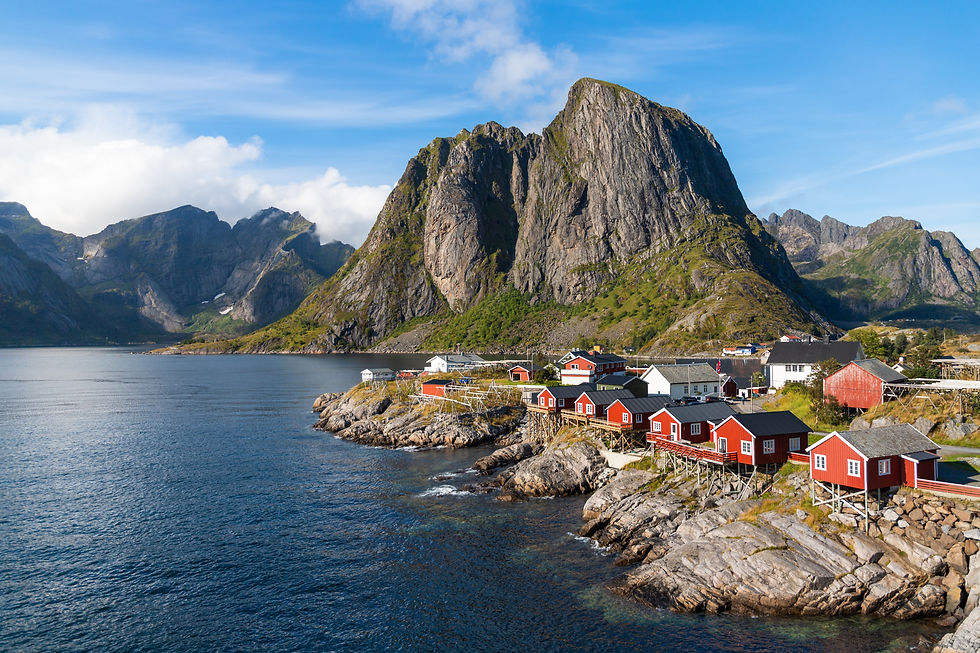
The landscape is made of sharp peaks, deep inlets, small harbours and fishing villages whose red cabins look especially vivid against snow. Reine, with its cabins beneath steep mountains, is one of the best-known views. The scale is intimate, since distances are modest, but the roads can be slow in winter and daylight is limited in the darkest weeks.
It is important to be realistic. Lofoten in winter is not about doing many things. It is about being in a few places properly, with an unhurried schedule that allows you to follow the weather.
The northern lights in Lofoten
The aurora season in northern Norway runs from September to early April, and Lofoten is within it. Many guests find Lofoten appealing for the aurora because the setting is so strong: green light above red cabins, mountains and a still bay. Skies can be darker away from larger towns, which helps.
The cautions are the same as everywhere. The northern lights are never guaranteed, and the weather in Lofoten can be more changeable than in Tromsø, so several evenings are essential. We discuss the specifics in northern lights over Lofoten. If the lights are your priority, many of our guests base themselves in Tromsø, which lies under the aurora oval, and add Lofoten for scenery and stillness.
Getting there and moving around
Lofoten is not close to Tromsø in a practical sense. It can be reached by road, by sea or by air, and each has its own rhythm. Roads cross a series of bridges and tunnels, and winter driving can be demanding, which is why we arrange drivers and keep driving days modest. Sea and air connections exist as well, and we choose the route that fits your dates.
For planning purposes, assume that moving between Tromsø and Lofoten takes a large part of a day, and that you should not schedule anything ambitious on the same day. It is a good reason to keep your number of bases low. Our guide to combining destinations without fatigue offers more advice, and the published itinerary across Tromsø, Senja and Lofoten shows one way to do it.
What to do in Lofoten in winter
Scenic drives and fishing villages
The simplest pleasure is to drive slowly with a private driver-guide, stopping where the light is good. Small harbours, beaches under snow and viewpoints over the fjords all work well, and you can stop for a hot drink when you are cold. This is what a private journey is for: the day follows the weather.
Ski touring
Lofoten is one of the places where we arrange ski touring, along with the Lyngen Alps and Senja. The mountains rise directly from the sea, which means skiing from summit to shoreline. It needs experience, good conditions and an expert guide. Our team includes an IFMGA mountain guide and a Norwegian avalanche instructor. Read about the ski-touring options at Legendary Adventure, and for the wider picture see the Lofoten page.
Winter walking and coastal hikes
Short guided walks along the coast or in sheltered valleys can be lovely in snow, with the right equipment and a guide who knows which routes are safe. Conditions decide, and routes are adapted accordingly.
Food by the sea
Northern Norway is known for local ingredients and fine wines, and our culinary journeys draw on both. Winter in a fishing village, with a table by a window and the sea outside, is among the quieter luxuries of the region. We do not name restaurants, because the best choice depends on the day and the lodging.

Where to stay and how long
Lodging in Lofoten ranges from secluded wilderness cabins to private apartments and lodges. We choose according to your dates and the kind of nights you want, and we never publish property names. The main question is whether you want to be in a village or somewhere remote, since the experience differs. A cabin on the water is wonderfully quiet but may be further from dining, while a village base gives more life.
For length of stay, we usually suggest at least three nights in Lofoten if it is part of a longer journey, and four or five if you want to slow down. Two nights seldom justify the travel. A shape that works well is:
Three to four nights in Tromsø for the aurora, hiking and fjords.
Three nights in Lofoten for the scenery and the quiet.
A transfer day with nothing else planned.
The journey can also run in the other order, and it can include Senja between the two, as the sample 7-day route shows. Our article on Senja explains why that island makes a good bridge between the two.
Is Lofoten in winter right for you?
A simple decision aid is below.
Book it if you value landscape, silence and slow days, and you are comfortable with a flexible plan.
Book it if you want a journey of at least seven days, so that the travel is not the main event.
Book it if you are travelling as a couple and want something quieter and more remote than Tromsø.
Skip it if you only have three or four days, in which case Tromsø alone will serve you better.
Skip it if the northern lights are your single priority, because Tromsø offers the strongest base for them.
Skip it if you dislike unpredictable weather and long drives in winter.
If you are still deciding, our Lofoten guide covers the islands across the year, and the destinations overview at legendaryarctic.com/destinations compares the options.
Pace, light and the shape of a day
In the darkest weeks, Lofoten gives you only a few hours of usable daylight, and it is wise to plan around them. A typical winter day might begin with a slow breakfast, a drive or short walk through the middle of the day, when the light is best, and a long afternoon indoors with a view. The evening is then free for dinner or the sky. This rhythm feels indulgent and is in fact the sensible way to enjoy the islands.
Later in winter, from February onwards, the daylight lengthens quickly and the options widen. Ski touring, longer drives and coastal walks all become easier, and the light on snow is spectacular. If your dates are flexible, February and March often give the best balance of daylight and winter atmosphere, while December and January give the deepest darkness and the strongest sense of remoteness. Our guide to Northern Norway month by month sets this out.
Whatever the month, we suggest leaving one day in the middle of your Lofoten stay without fixed plans. The weather will decide what is possible, and a spare day is the cheapest insurance against a stormy forecast. Guests who build in that margin almost always feel the trip was calmer and richer for it.
Frequently asked questions
Can you see the northern lights in Lofoten?
Yes, the aurora season runs from September to early April, and Lofoten is within it. The lights are never guaranteed, and weather can be changeable, so plan several evenings. Many guests base themselves in Tromsø for the lights and add Lofoten for scenery.
How many nights do I need in Lofoten?
We suggest at least three nights if Lofoten is part of a longer journey, and four or five for a slower pace. Two nights rarely justify the travel involved, particularly in winter when daylight is limited.
Is it safe to drive in Lofoten in winter?
Winter roads can be demanding, with snow, wind and limited daylight. That is why we arrange professional drivers and keep driving days modest. Guides decide whether a route is safe, and plans are adapted to conditions.
Can I combine Lofoten with Tromsø and Senja?
Yes. Multi-destination journeys are a speciality. We recommend keeping the number of moves low and allowing a transfer day with nothing else planned. A seven-day route across all three is possible.
Is Lofoten suitable for non-skiers in winter?
Yes. Scenic drives, coastal walks, local food and northern-lights evenings all work without skis. Ski touring is an option for experienced skiers with an expert guide, and it is one of several ways to experience the islands.
Plan your Arctic journey
If Lofoten in winter appeals, tell us when you would like to travel and whether you want to pair it with Tromsø or Senja, and we will shape a route that suits the season. We reply within one business day with first ideas.


Comments