
Senja in Autumn: Colours, First Aurora and Quiet Roads

Senja in autumn is the island at its most quietly beautiful. The summer visitors have gone, the slopes turn amber and rust against dark granite, the light grows lower and more directional, and on clear nights in September and October the first northern lights of the season begin to appear. It is also a month or two when a journey here feels almost private: the roads are empty, the lodges are calm and the whole island seems to slow down.
For a couple who like landscape, photography and quiet, autumn may be the best time to see Senja. This guide explains what the season looks like, how we would build a few days around it, and the honest trade-offs of travelling in the shoulder season.

What autumn looks like on the island
The colours of Northern Norway in autumn come from low vegetation, birch and mountain heath rather than from tall forest, and the effect is intense. In early to mid-September, the slopes tend to shift from green to gold, then to deep red and brown, often within a couple of weeks. By October the colours fade, the first snow can dust the peaks, and the landscape turns more austere.
The exact timing varies from year to year, so we never promise a particular week. What we can say is that the combination of colour, low sun and dramatic peaks is among the most photogenic the region offers. The mountains of Senja, jagged and steep, rise directly from the sea, and in autumn light they seem sharper, with deeper shadows and warmer tones than in midsummer.
The weather deserves honesty. Autumn is changeable, and rain and wind are common, particularly on the coast. A day can bring sun, cloud, rainbows and showers within hours. We see that as part of the character of the season, and we plan around it with flexible days and good shelter. Our guide to the Arctic autumn in Northern Norway describes the season as a whole.
The first northern lights
The northern lights season in Tromsø begins in September, and the same sky conditions apply on Senja. In early autumn, the nights are dark enough for the aurora while the weather is still milder than in midwinter, which many guests find a pleasant combination. Senja is far from city lights, and a clear night can reveal a lot of sky.
As ever, we cannot promise the lights. They depend on solar activity and clear skies, and neither can be predicted reliably far ahead. What we can do is give you several nights, choose accommodation with a clear view, and keep the schedule flexible so that a clear evening is never wasted. A night on the island can begin with a quiet dinner and end with a walk outside under the sky.
If you want to know how the northern lights work in the region, our guide to the northern lights on Senja explains what to expect. For the wider picture of the season, see autumn northern lights in September and October.
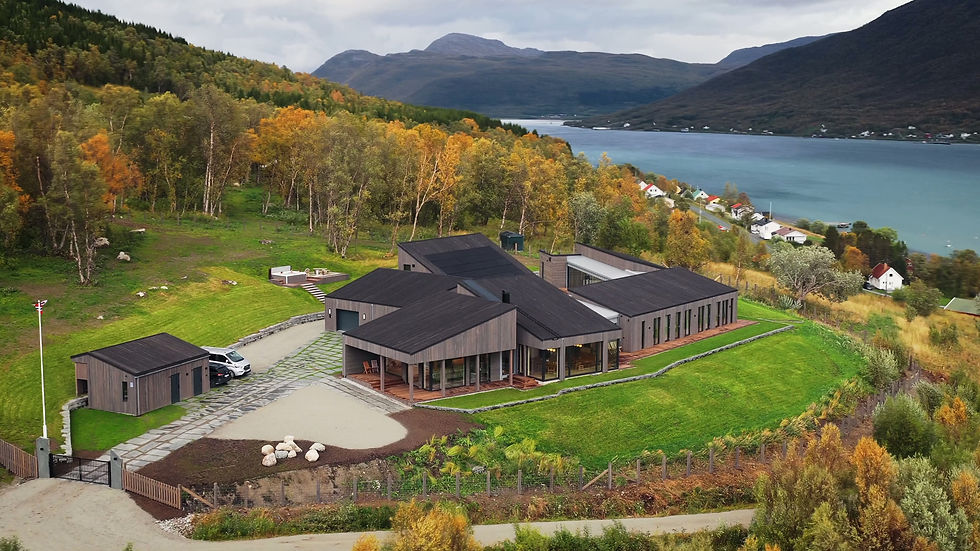
Where to stay, and why it matters more in autumn
In autumn, you spend more time indoors than in summer, and the right accommodation makes a real difference. A room with a large window facing the water, a warm and quiet interior and a place to watch the weather change are all part of the pleasure. We typically propose one of three kinds of stay on Senja.
The lodge with a view
A modern lodge with large windows above a fjord is perhaps the most characteristic choice. You wake to changing light, eat well and watch the sky from a comfortable chair. It suits couples who want comfort and scenery in equal measure.
The private apartment
An exclusive private apartment offers more independence and space, and works well for guests who like to cook, read or work quietly between outings. It is also a good choice for longer stays.
The secluded cabin
A secluded wilderness cabin is the most atmospheric option, with a focus on silence and darkness. It requires more planning, and we discuss access, heating and supplies in detail before proposing it. Our guide to where to stay on Senja sets out the options.
A sample four days
This is the shape we might propose for a couple in late September, as part of a longer journey or as a short stay. It is a sketch, adapted to weather and to what you want.
Day one, arrival and settling in. A private transfer to the island, a late lunch, a short walk near the lodge and an early dinner. We keep the first day light because the journey is tiring.
Day two, the scenic route. A full day with a private driver-guide along the coast, with stops at viewpoints, beaches and small villages. A long lunch with local ingredients, and photography wherever the light is good. The Senja scenic route is typically a ten-hour day trip, and we pace it so it never feels rushed.
Day three, a slow day. A late start, a walk along a headland, a sauna or a soak, and a quiet evening in the hope of a clear sky. We build in a day without a schedule, because the island rewards it.
Day four, a last look and a return. A morning walk or a drive to a favourite viewpoint, then a transfer back to Tromsø in the afternoon.
If you prefer a little more activity, a guided walk on a coastal path, a fishing outing or a boat trip can be added. Our guide to the Senja scenic route explains the day in more detail.
Photography and light
Many guests come to Senja in autumn specifically to photograph it, and the season offers a great deal. The sun stays low through much of the day, giving long shadows and warm tones for hours, and the combination of water, rock and colour can produce striking images without any special equipment.
A few simple principles help. Early morning and late afternoon give the best light, and a calm day produces reflections on the fjord that double the drama of the peaks. A wide lens is useful for landscapes, while a modest zoom can isolate details on distant slopes. For the northern lights, a sturdy tripod, a fast wide lens and warm gloves are the basics. Our guide to photographing the northern lights covers settings in more detail.
If you would like help, we can include a private guide who knows the best viewpoints and the light on each, so that you spend your time making pictures rather than looking for places. Photography is easier when someone else is driving.
Autumn trade-offs, and who it suits
We would rather be honest about the shoulder season than oversell it. Autumn has real strengths: fewer visitors, rich colour, softer light and a calmer pace. It also has trade-offs. The weather is more changeable, days shorten quickly through October, and some seasonal experiences are not available. Snow can arrive on higher ground, and some mountain routes become less accessible as the season advances.
Book it if you value quiet, landscape and photography, and are comfortable with changeable weather.
Book it if you want a chance of the first northern lights without the full cold of midwinter.
Skip it if you want deep snow, dog sledding or snowmobiling, which depend on winter conditions.
Skip it if you need guaranteed clear skies. No season can offer that, and autumn is no exception.
For many guests, the best answer is to combine Senja with a few days in Tromsø, so that the quiet of the island is balanced by the comfort of the city. We are happy to design that, and our guide to travelling in the shoulder season offers more perspective.
Frequently asked questions
When are the autumn colours at their best on Senja?
Typically from early to mid-September into early October, though the timing varies from year to year and we cannot promise a particular week. Colours usually fade through October as the first snow arrives on higher ground. We help you choose dates that give you the best chance.
Can we see the northern lights on Senja in autumn?
Yes, on clear nights. The season begins in September, and Senja's distance from city lights helps. The northern lights are never guaranteed, so we recommend several nights and a flexible plan. Clear skies and solar activity both need to cooperate.
How long should we stay on Senja?
We usually suggest three or four nights, which allows time for the scenic route, a slow day and a clear evening or two. Many guests combine Senja with Tromsø or Lofoten in a longer journey, so that the quiet of the island is balanced by other experiences.
What should we wear in autumn?
Layers, a waterproof and windproof shell, sturdy boots, a hat and gloves. Autumn weather changes quickly on the coast, and wind can make it feel colder than the temperature suggests. Wool or synthetic base layers work better than cotton, and we send a full list before you travel.
Is autumn busy on the island?
Much less than in midsummer. Most visitors come in summer, so autumn tends to be quieter, with calmer roads and lodges. That is part of the appeal for guests who prefer privacy. We still recommend booking early for the best accommodation.
Plan your Arctic journey
If a quiet autumn on Senja appeals to you, tell us when you would like to travel and whether you want to add Tromsø or Lofoten. We reply within one business day with first ideas.


Comments