
Slow Travel in Northern Norway: Fewer Moves, Deeper Days

The map of Northern Norway invites ambition. Tromsø, Senja, Lyngen, Lofoten: each has a famous name, and each is a plausible stop on a week in the Arctic. The temptation is to see them all. The result, too often, is a trip made of check-in times, long drives and tired evenings, with the landscape reduced to a view from a car window.
Slow travel is the alternative, and in the Arctic it is not a luxury affectation but a practical advantage. The weather changes, the light moves, and the best moments cannot be scheduled. A journey with fewer bases, longer stays and space between activities gives all of that room to happen. This article sets out what slow travel looks like here, who it suits, and how we plan it for couples and small groups.
What slow travel means in the Arctic
Slow travel is not the same as doing less. It means choosing depth over breadth. In practice that usually looks like two or three nights in each place rather than one, a limit of two bases in a week, mornings without alarms, and one planned activity per day rather than three. It also means leaving unplanned time for the day to take its own direction: a stop at a beach because the light is good, a long lunch because the fjord is calm, an early night because the previous evening ran late.
The Arctic environment suits this approach. Distances in Northern Norway can be large, and winter driving is slower than it looks on a map. Daylight in the darker months is brief, so each hour has to be used well. And the northern lights, whatever else you hope for, cannot be scheduled. A slower journey gives you several nights in the same area, which is exactly what improves the chances of a clear sky without any promise being made.
There is a quieter benefit too. Staying put lets you notice things: the way the harbour changes colour between two and four in the afternoon, how a particular ridge catches the last light, what a small town sounds like at night. Those details are the substance of a journey, and they are the first things lost to a fast itinerary.
Why fewer bases make a better journey
Each change of accommodation costs a half day. There is packing, there is transport, there is the small mental effort of finding your bearings, and there is the fatigue that builds when it happens too often. Over a week with four moves, you can easily lose two full days to logistics. Over a week with one or two, those days become experiences.
A base also gives you a sense of belonging. By the third night you know where to find coffee, which side of the room catches the morning light, and where the guide will meet you. That familiarity is surprisingly relaxing, and it is what many guests describe as the point at which the holiday begins.
A simple rule we use
For a journey of up to five nights, we usually recommend one base. For six to nine nights, two. Beyond ten, three at most, and only when each is distinct enough to justify the move. Our guide to planning a multi-destination journey in Northern Norway goes into the logistics for those who do want to combine regions.
Three slow rhythms for two people
To make this concrete, here are three outlines. They are illustrations of rhythm rather than finished itineraries, and all of them would be adapted to your season, your dates and your interests.
Five nights, one base: Tromsø
Arrival, a private transfer and an early night.
A gentle morning, a short guided outing in the afternoon light, an evening at leisure.
A full private day on the coast and fjords, with a long lunch, followed by a rest.
A late morning, a quiet afternoon, and a private northern lights evening.
A spare day held for weather, a second attempt at the sky, or a lie-in.
This is the pattern most of our guests choose for a first visit, and it is explained further in our five-day Tromsø itinerary.
Eight nights, two bases: Tromsø and Senja
Three nights in Tromsø for the city, the fjords and the first aurora evenings.
A scenic drive to Senja, taking the route slowly, with stops.
Four nights on Senja, with two full days of walking, photography and rest, and the sort of evenings that depend on cloud.
A return to Tromsø for the final night and a relaxed departure.
Ten nights, three bases: Tromsø, Senja and Lofoten
Three nights in Tromsø.
Three nights on Senja, with unhurried days in the mountains.
Four nights in Lofoten, where the scenery tempts you to rush but rewards patience.
Each of these keeps at least two nights in every place, protects at least one open day per base, and avoids driving on the day of any important experience. The longer your stay, the more important the open days become.
Choosing places for slowness
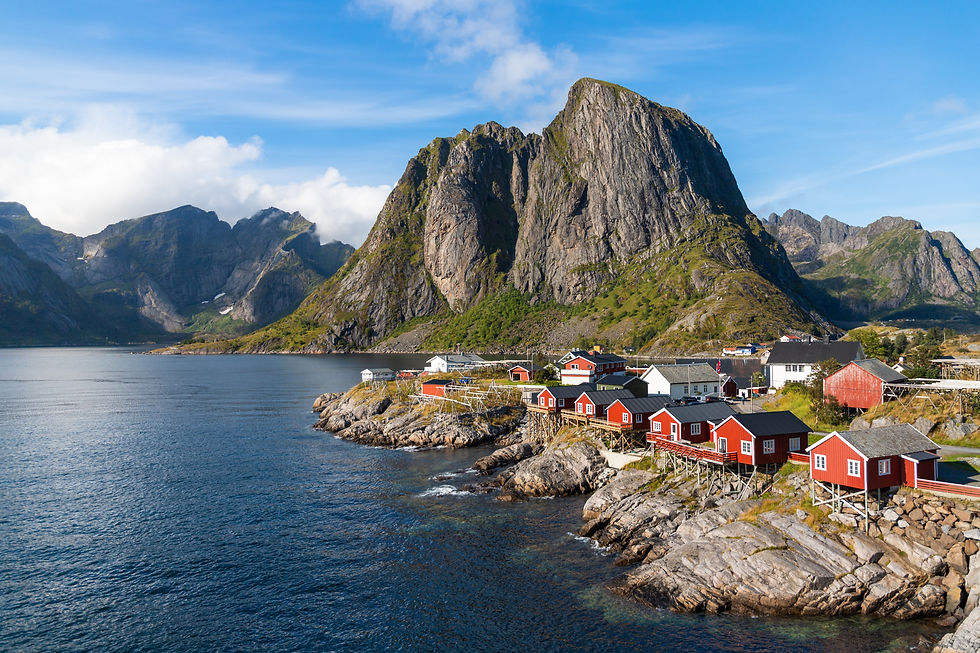
Different places invite different paces. Tromsø is the easiest base: a compact city with excellent restaurants, a harbour, a cable car and direct access to fjords and the countryside, which makes it ideal for a first visit or a stay of several nights. Senja, sometimes called the fairytale island, is wilder, with jagged peaks, quiet bays and long coastal roads. Lofoten is dramatic, with red fishing cabins beneath steep mountains and beaches that look almost tropical in summer light. Lyngen, the alpine wilderness, rewards those who like mountains, particularly in ski-touring season.
If you are unsure how to choose between them, our comparison of Senja and Lofoten and of Tromsø and Lofoten will help. The honest answer is often that you should choose one and do it well. A return trip to another region is not a failure of planning but the beginning of a relationship with the Arctic.

How slow days are built
A slow day is not an empty one. It has a structure, with enough give to let the day change shape. We use a small number of building blocks.
An anchor. One experience that defines the day: a private fjord drive, a guided snowshoe outing, a visit to a reindeer farm, a long lunch somewhere with a view.
A buffer. A gap of at least two hours before and after, so that nothing feels rushed.
A retreat. A warm place to return to, whether a lodge, a private apartment or a secluded cabin, where the evening can unfold quietly.
A reserve. A spare evening or morning, kept free in case weather or mood alters the plan.
The anchor is the only thing booked in detail. Everything else is allowed to flex, and the private format makes that possible. A guide with a vehicle and a flexible schedule can change direction when the sky changes, or turn a half day into a whole one because the conditions are special.
Who slow travel suits, and who it doesn't
Slow travel suits you if you are travelling as a couple or a small group, value atmosphere over ticking things off, have at least five or six nights, and would rather return to Norway than try to cover everything at once. It is especially good for honeymoons, anniversaries and milestone trips, where the pleasure is in being together somewhere remarkable.
It may not suit you if you have only three or four days and a long wish list, or if you thrive on a full schedule. In that case a compact itinerary with a firm structure may feel more satisfying, and we are happy to build one. The point is not that slow is always right, but that more is not always better.
Whatever pace you choose, there are a few common-sense measures that make a slower journey run smoothly: arrive rested, avoid scheduling important experiences on travel days, and allow a day of buffer on either side of any flight home. A calm, well-paced trip also tends to make better use of the weather. If you are curious how we think about planning more broadly, our page on destinations shows how the regions fit together, and every journey includes a personal digital dashboard that keeps the day-by-day plan in one place.
Frequently asked questions
How many nights do I need for a slow journey?
Five nights in one base is the minimum we usually suggest for a first visit. Six to nine nights allows two bases, and ten or more can support three. The longer the stay, the more important it is to keep open days in each place.
Is slow travel more expensive than a fast itinerary?
Not necessarily. Fewer transfers and fewer simultaneous activities change how a budget is spent rather than how much. Journeys are priced as one complete experience, and we ask for a budget idea at the start so that the pace and the quality can be matched.
Can I still see the northern lights on a slow journey?
Slow travel improves your chances of seeing them because it gives you several evenings in the aurora season, from September to early April. The northern lights are never guaranteed, but a calm schedule lets you take advantage of clear skies when they appear.
Which Arctic destination is best for slow travel?
Tromsø is the easiest and most flexible base. Senja and Lofoten are wilder and reward longer stays, and Lyngen suits mountain lovers. We help choose according to season, interests and how much driving you want.
What if I only have a long weekend?
A long weekend can still be unhurried if it has one base and one or two anchored experiences. It is a short stay, so we suggest being realistic about what fits and treating it as a first taste, with a longer visit in mind.
Plan your Arctic journey
A slower journey needs more careful design than a fast one, and that design is what we do. Tell us when you hope to travel and who is coming, and we reply within one business day with first ideas.


Comments