
Senja or Lofoten: The Quieter Island or the Famous One?

Choose Senja if you want dramatic mountains and sea with few other people, and an easy extension from Tromsø. Choose Lofoten if you want the famous archipelago: red fishing cabins, long beaches under steep peaks and a longer, more layered journey. Both are extraordinary. The difference is mainly one of scale, distance and atmosphere, and it matters more than most comparisons admit.
We plan journeys to both every season, often for couples who cannot decide. The short version is that Senja feels like a private discovery and Lofoten feels like a destination in its own right. One is a long, rewarding day or a few quiet nights. The other asks for several days and repays them.
This article sets the two side by side in the way we would at a planning table: landscape, getting there, time needed, seasons, northern lights, and the type of traveller each suits. If you are comparing Tromsø itself with the islands, our guide to Tromsø or Lofoten is the companion piece.
The landscape: two different kinds of drama
Senja
Senja is often called the fairytale island, and the description is fair. Along its outer coast, jagged peaks rise straight from the sea, and the scenic route threads between fjords, headlands, white beaches and small settlements. Viewpoints such as Tungeneset, with its sharp peaks mirrored in the water, are among the most photographed places in the north, yet still feel uncrowded compared with the better-known islands further south.
Senja is varied in a compact way. Within a single day you can move between a sheltered fjord, an exposed outer coast and a pass with wide mountain views. It feels wild without feeling remote.
Lofoten
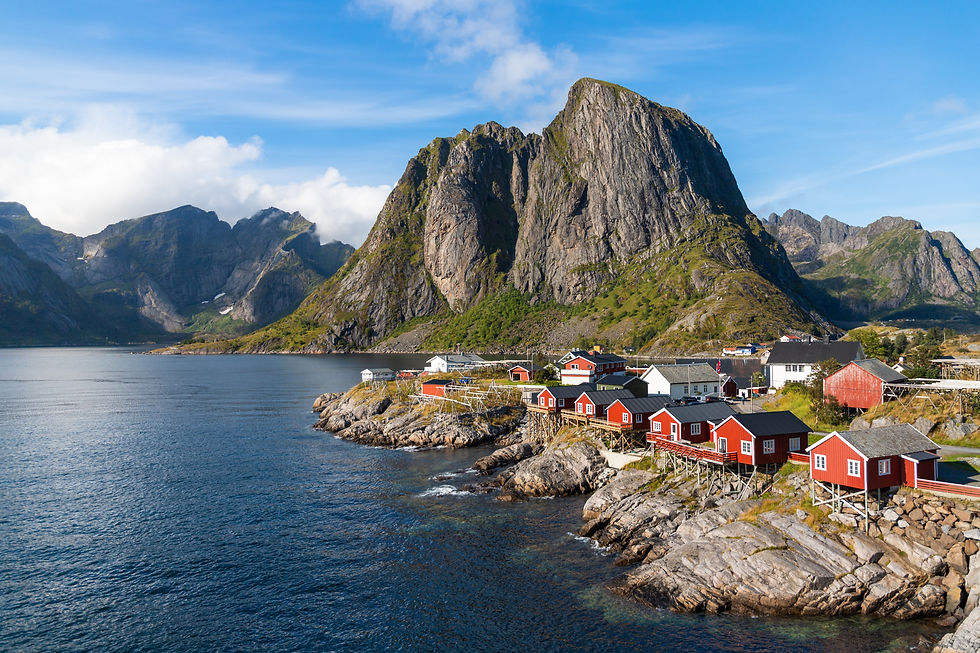
Lofoten is a chain of islands defined by a wall of mountains rising from the Norwegian Sea. The villages, with their red and ochre cabins on stilts, sit in a way that has become a symbol of the Arctic coast. Reine, in particular, is a postcard of the region. Beaches with pale sand and clear turquoise water sit beneath granite peaks, and the scale is larger than most visitors expect.
The result is a landscape that rewards time. A single viewpoint is impressive; a week of driving, walking and eating along the islands builds into something deeper.

Getting there and time needed
This is where the two differ most, and where many plans go wrong. Senja lies relatively close to Tromsø. A private drive along the scenic route can be done in a long day of around ten hours, and it is also easy to stay a night or two on the island itself. For couples who want to add the island to a Tromsø stay without a big logistical step, it is the simpler choice.
Lofoten is further, and the journey is part of the planning. Depending on the season and what you want to see, it can be reached by road, by air to one of the regional airports, or by a combination of methods. We cover the options in our article on how to travel from Tromsø to Lofoten. As a rule of thumb, we recommend at least three nights in Lofoten and ideally four or five, so that you are not spending most of the time in transit.
For a journey of five to seven days, the usual split is simple. Either you base in Tromsø and add a day or two on Senja, or you divide the week between Tromsø and Lofoten. A journey that tries to include all three needs ten days or more to avoid feeling rushed. Our piece on planning a multi-destination trip explains how we pace it.
Season by season
Both destinations change character through the year, and the right choice sometimes follows the calendar.
Autumn (September to October). Colour on the hillsides and the first aurora nights. Both are lovely; Senja is especially photogenic with autumn colours against the dark peaks.
Early winter (November to January). Polar night light, deep blue twilight and snow. Senja is a good winter day or short stay from Tromsø; Lofoten is spectacular but needs more careful planning around daylight and weather.
Late winter (February to April). Longer days and stable weather. Both work well, and this is a popular time for ski touring on Senja and in Lofoten.
Summer (late May to July). Midnight sun. Lofoten's beaches and hiking trails are at their best, and Senja has long evening light on the outer coast.
To go deeper, see our guides to Senja in winter and Lofoten in winter, and the general overview of Senja.
Northern lights and night skies
Both Senja and Lofoten sit within the northern-lights region, and both offer dark skies away from city lights. Lofoten, with its mountains, sea and fishing villages, makes a dramatic foreground for the aurora, and its darker settings are a draw for photographers. Senja offers a similar mix of mountains and water, with quieter spots and less light pollution.
Tromsø is often the more reliable base for aurora planning, because it sits under the auroral oval and has well-tested options for driving inland when clouds cover the city. The islands add atmosphere rather than reliability. If the northern lights are your main priority, we usually suggest putting the first nights in Tromsø and treating the islands as an addition, not a replacement. Northern lights are never guaranteed anywhere, and a longer stay always improves your chances.
If you do want to sleep somewhere remote under the sky, wilderness cabins and lodges can be arranged on both. We avoid naming properties in articles, but we can tell you which kinds of stay fit your plan when you get in touch.
Who each island suits
Senja suits you if
You want a quiet, scenic addition to a Tromsø stay.
You value space, calm and fewer visitors.
You like the idea of a long scenic day with private driving, or one or two restful nights.
You have five to seven days in total and do not want to spend them travelling.
Lofoten suits you if
You want the classic image of the Arctic coast and the time to explore it properly.
You have at least ten days, or a week that you are happy to devote mostly to the islands.
You like walking, photography, sea views and a sense of slowly travelling.
You are planning a special occasion where scale and scenery are part of the memory.
Some travellers choose both over a longer journey. In that case, we suggest travelling slowly and keeping moves to a minimum, since two or three well-chosen bases feel more luxurious than five hurried ones.
How we would plan it for two
If we were designing a journey for a couple with seven days, we would normally recommend this shape: four nights in Tromsø with two or three evenings kept for the northern lights, a long private day to Senja along the scenic route, and a gentle final evening in the city. It keeps the aurora flexibility of Tromsø, gives you the island at its best and avoids a lot of repacking.
With ten days, we might add a Lofoten leg of three or four nights, with transfers handled privately and a stay chosen for the view and the quiet. With two weeks, we might connect all three in a loop. In each case, the journey is priced and planned as a whole, so you are not assembling separate bookings yourself.
The trip-design fee and payment terms are set out on our pricing page, and we ask for a budget idea at the start so that we design something realistic.
Frequently asked questions
Is Senja or Lofoten better for a first Arctic trip?
For a first trip of about a week, Senja is usually easier because it sits close to Tromsø and adds scenery without much transit. Lofoten is better if you have ten days or more and want to explore properly. Many first-timers do Tromsø and Senja, and return later for Lofoten.
Can you do Senja as a day trip from Tromsø?
Yes. The scenic route can be done as a long private day of about ten hours, with stops at viewpoints and villages. It is an excellent way to see the island, though staying a night or two allows a slower pace and more flexibility with the light.
How many nights should we spend in Lofoten?
We recommend at least three, and ideally four or five. Lofoten is spread out, and travel to and from Tromsø takes time. A shorter stay can feel like transit with a view, while a longer one lets the islands settle in.
Which is better for the northern lights?
Both are good, and both are in the aurora region. Tromsø is usually the stronger base for planning because it sits under the auroral oval and has flexible options when clouds cover the city. The islands add dramatic scenery. Nothing is guaranteed anywhere.
Can we combine Senja and Lofoten in one journey?
Yes, usually with Tromsø as the starting point. We suggest at least ten days so you are not rushing. Multi-destination journeys are a speciality of ours, and we arrange private transfers and stays so the moves feel smooth.
Plan your Arctic journey
If you cannot decide between Senja, Lofoten or both, tell us how many days you have and when you want to travel, and we will reply within one business day with first ideas.
Comments